Locating Intersectionality Sociologically
Media
Image

Blog content
Kevin Ralston 2023
I want to be super clear from the outset. This blog is not a ‘critique’ of intersectionality or intersectional thinking. The term, the concept, and the way it has been communicated, has had a huge and positive impact in highlighting the complex multifaceted nature of inequality. The purpose of the blog is to try to better contextualise (locate) this in relation to preceding research that applied the approach.
Intersectionality has become an extensively used general term in sociology and well beyond. With, for example, health researchers now commonly ‘applying an intersectionality lens’. The concept of intersectionality is so widespread and successful it feels as though it hardly needs defined. Nevertheless, for the small number of people likely to read this, who do not already know the concept, the Centre for Intersectional Justice describes intersectionality as:
…the ways in which systems of inequality based on gender, race, ethnicity, sexual orientation, gender identity, disability, class and other forms of discrimination “intersect” to create unique dynamics and effects.
Kimberlé Crenshaw is credited with coining the term ‘intersectionality’. Crenshaw herself is from the field of law.
In 2013 Cho, Crenshaw and McCall wrote of the expansion of intersectional analysis:
… intersectionality has emerged in a number of discursive spaces, the projects and debates that have accompanied its travel have converged into a burgeoning field of intersectional studies. This field can be usefully framed as representing three loosely defined sets of engagements: the first consisting of applications of an intersectional framework or investigations of intersectional dynamics, the second consisting of discursive debates about the scope and content of intersectionality as a theoretical and methodological paradigm, and the third consisting of political interventions employing an intersectional lens.
The graph below illustrates the growth in the use of the term, intersectionality. It is from the search engine Google. It can be seen that there is a clear increase in the relative use of intersectional as a search term from around 2009, with a steadily rising trend to the present.
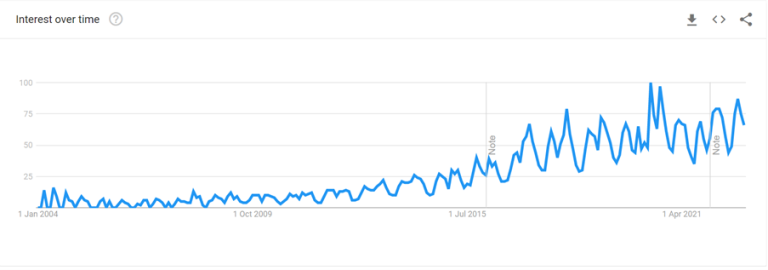
The clear rise in searches involving the term ‘intersectionality’ does not necessarily indicate a rising trend in intersectional research. This is because the type of approach described as intersectional has been central within empirical sociology long before the term emerged.
It might be tempting for scholars and students, new to thinking sociologically about inequality, to treat the coining of the intersectional terminology as the beginning of this type of thinking. It is important to acknowledge that the practice of intersectional analysis has existed for many decades prior to this. I argue that intersectionality should be understood as part of this ongoing body of analysis, and set in that context.
For example, in 1980 scholars of social stratification from Cambridge published a book that argued for the need to understand social relationships as social processes. In this they wrote that:
‘Men and women, blacks and whites, qualified and unqualified, propertied and proletarians-whatever the division we make are all part of the social whole. Thus an explanation of structured inequality must fit them all. We do not, of course, mean that the explanation will be exactly the same in relation to each … For example, if skin colour were purely a personal characteristic, it would not be relevant to systematic inequalities, but in fact the experience of being black (or proletarian or female) is a social experience.’
This clearly fits with an approach that would later be defined as intersectional. In the monograph the authors argue for the need to understand characteristics such as race, sex or educational attainment within theory that acknowledges processes of dominance in relation to the economic and social system(s).
Over 30 years later Cho, Crenshaw and McCall were writing that the growing field of intersectionality consisted of application, debating theoretical scope and content and also policy intervention. In this respect the Cambridge authors were arguably beyond intersectional in their conceptualisation. The multiple nature of dominance was fully expressed and they identified scope for the theoretical explanation necessary. In any case, the example illustrates that the type of thinking defined as intersectional existed decades prior to the term.
As a sociologist used to working with statistical approaches, when I first came across intersectionality I recognised the ideas as an expression of a multivariate analysis and intersectionality as interactions.
In a statistical model an interaction assesses whether the relationship between an explanatory ‘variable’ and an outcome variable, varies by levels of a third variable. So, for example, Ortega and Myles (1987) examined whether gendering in the experience of fear of crime varies by ethnicity (race). This is, again, a clear example of an intersectional approach. This sort of analysis is not an outlier, it is mainstream criminology typical of an empirical multivariate approach necessary to understand complex social systems. This is simply how sociology (and criminology) was and is being done.
Many years ago I read an article arguing that a problem related to the ‘success’ of sociology is that many other fields have absorbed sociological thinking wholesale. This blurs and obfuscates, making it difficult to establish clear boundaries between sociology and other disciplines. Nevertheless, the widespread adoption of sociological thinking is arguably a strength. It demonstrates the general application and utility of sociological approaches.
Cross fertilisation between fields is useful. It may be beneficial for the progression of science. It is a success that ideas on the conceptualisation of inequality had become so widespread that it can (re)emerge from the field of law, reinvigorated and re-expressed so that it resonates and gains new traction and impetus. Yet, we do our own discipline a substantial disservice if we do not acknowledge or trace the contribution our own discipline has made.
To be clear, no one is arguing that before we knew the term intersectional, we did not understand inequality, and intersectionality came along and sorted it all out. Yet, as researchers, teachers, or students, it is tempting to be drawn to the term, intersectionality, and begin our thinking from that point. Especially if intersectionality is not contextualised in relation to prior research and thinking that took the approach. It would be erroneous to believe that intersectional ideas were not understood prior to the terminology. This would imply an arbitrary and unjustifiable year zero and ignore the ‘intersectional’ research that existed in the decades before the term emerged.
Intersectionality the concept is hugely powerful. It seems to have a strength and a clarity that facilitates students, academics and policy makers to understand and communicate complexity. It is a term that has relatively recently been applied to a way of thinking about inequality that has been on-going and which had pre-figured the term. As sociologists we should locate intersectionality within the long sociological tradition of thinking about inequality in this way. This should help us to both better understand inequality and also to see the context and contribution of sociological thinking.
The quote below is from the article on the interaction between race and gender in the fear of crime by Ortega and Myles (1987), referred to above.
A condition of double or triple jeopardy can be said to hold when individuals occupying more than one devalued status suffer adverse objective or subjective consequences beyond those expected on the basis of their separate statuses.
If this had been written in 2017, rather and 1987 they would probably have used the term intersectional. As it is, Ortega and Myles describe exactly what would come to be called an intersectional approach. If Kimberlé Crenshaw had been reading this article as her thinking was developing, perhaps we would now be using a term like multiple-jeopardy instead of intersectionality. In 2013, Cho, Crenshaw and McCall wrote about the emerging field of intersectional studies. But studies applying intersectional approaches have a long history substantially pre-dating the ‘field’ by many decades.
Conclusion
Intersectionality is a massively useful way to conceptualise and communicate inequality. It is tempting to see the establishment of the term as the birth of a better or more sophisticated approach to inequality. The main point I have made in this blog is that sociologists have been thinking about inequality ‘intersectionally’, long before the term existed.
Intersectionality should be seen as an important and effective innovation in the communication of research of this type. I believe sociology would benefit from more explicitly locating intersectionality within this long run tradition of thinking sociologically about inequality. This argues that we should understand the use of intersectional terminology as part of a continuum of research of that type, rather than as the birth of a new field of studies. Failing to locate intersectionality in relation to preceding work that had applied the approach undervalues the contribution of the body of research that had long established and understood the multifaceted nature of inequality.
—
Image by wirestock on Freepik